A store can have a flawless Google Merchant Center feed — every SKU mapped, every attribute populated, every policy field filled — and still score zero on structured data for AI buyers. The two pipelines share no data path. GMC feeds go to Google Shopping. ChatGPT, Gemini, Perplexity, and Claude read the JSON-LD on your product pages. If that JSON-LD is missing, the AI buyer sees nothing, no matter how well your GMC feed is maintained.
This confusion is common because both systems use structured product data — a name, a price, a stock status, a brand. But the formats, ingestion paths, and consumer endpoints are entirely separate. A merchant who assumes GMC coverage equals AI readiness is invisible to every AI buyer except Google's own shopping surface.
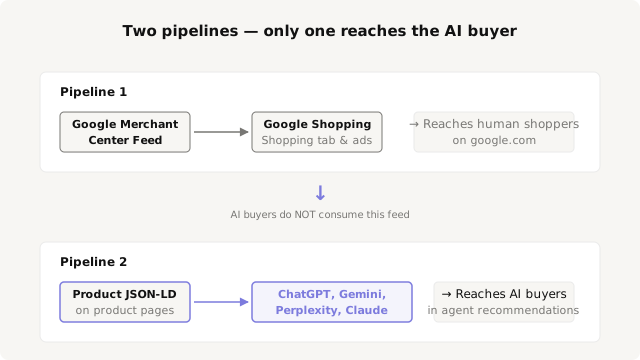
The two pipelines, side by side
Google Merchant Center is a feed-based system. You upload a CSV, XML, or API-delivered product catalog to Google's servers. Google validates the feed against its own attribute schema — gtin, mpn, price, availability, shipping_weight — and surfaces approved products in the Shopping tab, Shopping ads, and free listings. The feed is ingested at Google's end and never needs to appear on your website at all. A store could theoretically run GMC with no public-facing website beyond a checkout page.
AI buyers — ChatGPT, Gemini, Perplexity, Claude, and the growing category of browser-embedded agents — do not ingest GMC feeds. They crawl your product pages the way a search crawler would, and they extract product information from the structured data embedded in the page HTML: JSON-LD blocks, Microdata, or RDFa. The dominant format is JSON-LD @type: Product, placed in the <head> or <body> of each product detail page. If the page markup has no structured data, the AI buyer has to guess from prose — and it frequently guesses wrong, or skips the product entirely.
The overlap is zero. GMC does not generate JSON-LD on your site. JSON-LD on your site does not feed into GMC. They are parallel investments that serve different discovery surfaces.
What GMC gets right — and what it cannot do
GMC is excellent at what it was designed for: Google Shopping placement. A well-maintained feed gives your products visibility in the highest-intent shopping surface on the web. The attribute requirements are well-documented, the error reporting is granular, and the integration paths — from Shopify's automatic sync to custom API feeds — are mature.
But GMC is a single-channel investment. It optimizes for one buyer: the person typing a product query into google.com. It does not optimize for the buyer who opens ChatGPT and asks "what's the best running shoe for flat feet under $150" or the one who tells Perplexity "find me a wool coat that ships to Berlin by Friday."
Those buyers never touch a Google Shopping listing. The AI agent reads product pages directly, compares options, and presents a shortlist with reasoning. If your JSON-LD is absent or incomplete, the agent cannot confidently quote your price, confirm your stock, or recommend your product — so it picks a competitor whose data it can read.
Structured data is the feed AI buyers actually consume
The JSON-LD block on a product page is the functional equivalent of a GMC feed row — except it lives on your site, not Google's servers, and every AI crawler reads it. The fields that matter most to AI buyers overlap partially with GMC attributes but diverge in important ways:
| Signal | Required by GMC | Required by AI buyers |
|---|---|---|
| Product title | Yes | Yes |
| Price + currency | Yes | Yes |
| Availability (in stock / out of stock) | Yes | Yes |
| Brand | Yes | Yes |
| GTIN / MPN | Yes (for most categories) | Helpful, not required |
| Product image URL | Yes | Yes |
| Description | Yes (GMC) | Yes (AI uses it for comparison reasoning) |
| Shipping details in JSON-LD | No | Yes — AI buyers check delivery feasibility |
| Return policy in JSON-LD | No | Yes — AI buyers use it as a tiebreaker |
| Aggregate rating + review count | Optional | High-impact — AI buyers cite ratings as evidence |
sku or productID | Yes | Helpful for exact-match queries |
An AI buyer can work with a subset of these — a product with a name, price, and availability is already quotable. But each missing field reduces the agent's confidence and increases the chance it will recommend a competitor whose data is more complete.
The GMC-only trap
A merchant with a well-maintained GMC feed sees their products performing in Google Shopping and assumes the structured data piece is handled. It is not. GMC does not write anything to the merchant's website. The product page HTML remains unchanged, and AI crawlers visiting the page find whatever the page actually contains — which, for a surprising number of stores, is nothing machine-readable at all.
In our scans of 28 e-commerce stores in June and July 2026, 11 had zero product structured data on their pages. Several of those stores run active Google Shopping campaigns. Their GMC feeds are presumably well-maintained — the products appear in Shopping results — but an AI buyer visiting their product pages sees the same data layer a 2010 search crawler would see: HTML and prose, with no structured facts to extract.
The fix is not to abandon GMC. It is to add the layer GMC cannot provide: JSON-LD Product markup on every product detail page.
Adding JSON-LD does not duplicate your GMC investment
The practical concern most merchants raise is duplication of effort: "I already maintain all this product data in GMC. Why should I maintain it again in JSON-LD?"
The answer is that for most platforms, you do not have to maintain it twice. Shopify, WooCommerce, Magento, and BigCommerce all generate JSON-LD Product markup automatically from the same product catalog data that feeds GMC integrations. If you are on a modern e-commerce platform, the structured data is likely already present — check your product page source for <script type="application/ld+json"> containing "@type": "Product".
Custom-platform stores and headless builds are the exception. If your front end is a React or Next.js app that fetches product data from an internal API but does not render JSON-LD in the page head, you are in the GMC-only trap by default. Your API feeds GMC fine. Your page feeds AI buyers nothing.
The fix is a single <script type="application/ld+json"> block per product page, populated from the same product object your page already uses to render the title, price, and image. It is a few dozen lines of templating, deployed once.
The three things to check right now
If you want to know whether you are in the GMC-only trap, check three things:
- Open a product page. View source. Search for
application/ld+json. If you find a block with"@type": "Product"containingname,offers(withpriceandavailability), andbrand, your AI buyer pipeline is wired. If you find nothing, or a block that only containsWebSiteorOrganizationmarkup, your product data is not reaching AI buyers.
- Check your
robots.txtfor AI crawler rules. Even if your JSON-LD is perfect, blockingGPTBot,ClaudeBot,PerplexityBot, orCCBot(Common Crawl, used by many AI training pipelines) makes your pages unfetchable. An AI buyer cannot recommend a product it cannot read.
- Run a free scan at prefero.me. It checks all three dimensions — structured data, crawlability, and AI buyer preference — in one pass and gives you a score from 0 to 100, plus a list of exactly what to fix.
Google Merchant Center is one of the best investments in e-commerce distribution. But it reaches one surface. The AI buyers that now influence a growing share of purchase decisions read a different pipeline — one that depends entirely on what is in your page HTML. Make sure it is there.