6 stores in our June scan batch tested AI preference — the dimension that simulates whether an AI buyer would pick your store over a competitor selling the same product. They scored 40, 40, 80, 100, 100, and 100. A 40 loses. A 100 wins. The gap between them is 24 points on overall readiness — equivalent to the entire crawlability dimension. And 24 of the 30 stores we scanned never ran the comparison at all.
AI preference carries 40% of the Prefero readiness score, tied with structured data as the heaviest weight. Structured data measures whether your product schema exists. AI preference measures whether it is good enough to beat a competitor. The data from 30 scans across June tells a clear story: most stores fixate on getting their schema right and stop there. They ship valid JSON-LD, they unblock the crawlers, and they call the store ready. But when an AI buyer is comparing two stores that both have good structured data, schema quality is table stakes — the decision comes down to the signals the buyer model weighs in the moment. That is what AI preference captures. And most stores have no idea where they stand on it.
What AI preference actually measures
The AI preference dimension runs a simulated buyer — a Claude model acting as a shopper with a specific persona — and asks it to compare the scanned store against a real competitor URL for the same product. The buyer evaluates the two stores on product information quality, trust signals, shipping and return clarity, and overall purchase confidence, then declares a preference: store A, store B, or neutral.
The score is 100 if the scanned store is preferred, 40 if the competitor wins, and 50 if no competitor URL is provided — a neutral baseline that contributes nothing and costs nothing. That neutral 50 is what 24 of 30 scans received. They were evaluated in isolation, with no opponent, and their AI preference score reflects only that they chose not to enter the comparison.
This is not a criticism of how the tool is used. It is a signal of where the blind spot is. Merchants run a scan to check their schema and their crawlability — the things they can fix with a developer. AI preference requires a different instinct: the willingness to find out whether your store, even with perfect structured data, would lose the sale to someone else.
What the data shows
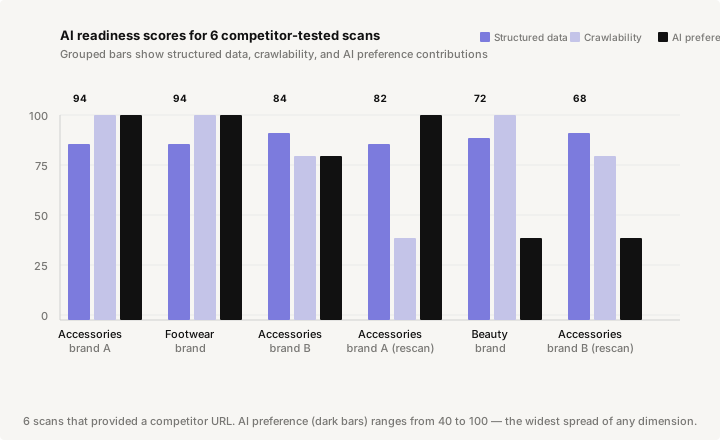
Across the 6 scans where a competitor URL was provided, structured data scores ranged from 82 to 91 — a tight, predictable band. Crawlability ranged from 40 to 100, with most at 80 or above. AI preference ranged from 40 to 100, split cleanly into two clusters: three scans scored 100 (the scanned store won), one scored 80 (moderate preference for the scanned store), and two scored 40 (the competitor won).
The stores that scored 100 on AI preference finished with overall readiness scores of 94, 94, and 82 — the last dragged down by weak crawlability that was unrelated to the buyer comparison. The store that scored 80 finished at 84 overall. The stores that scored 40 finished at 72 and 68 overall — losing 24 points on the heaviest-weighted dimension.
The pattern is consistent: structured data gets you into the conversation. AI preference decides whether you close.
Same store, different opponent
One accessories brand was scanned twice in the same week against two different competitors. Its structured data score was a constant 91. Its crawlability score was a constant 80. The only variable was the competitor URL.
Against the first competitor, the AI buyer preferred the scanned store with a score of 80 — strong but not dominant. Overall readiness: 84.
Against the second competitor, the AI buyer preferred the competitor. AI preference dropped to 40. Overall readiness: 68.
Nothing changed about the store. The same product pages, the same schema, the same crawl setup. The only difference was who the AI buyer was comparing against. And that difference was worth 16 points — a full letter-grade swing in readiness, from "solid" to "needs work."
This is what makes AI preference different from the other two dimensions. Structured data quality is a property of your store. Crawlability is a property of your store. AI preference is a property of the matchup — and the matchup changes depending on who else is selling the same thing.
Why 24 of 30 scans skipped it
Running a scan without a competitor is the path of least resistance. It requires only a store URL. Running one with a competitor requires finding a real competitor selling the same product at a comparable price, copying their URL, and being willing to see the result — even if it is unflattering.
The 24 scans that defaulted to neutral 50 on AI preference came from stores across apparel, accessories, footwear, home goods, coffee, tea, pet supplies, and beauty. Several had structured data scores above 85, crawlability at 100, and overall readiness in the high 80s or low 90s. Their reports told them their schema was excellent and their crawlers were unblocked — both true. What the reports could not tell them, without a competitor, was whether any of that would matter when an AI buyer had another option.
A neutral AI preference score of 50 contributes 20 points to the overall readiness score (50 × 0.4). A winning score of 100 contributes 40 points. A losing score of 40 contributes 16 points. The difference between winning and losing this dimension — 24 points — is larger than the entire crawlability dimension (capped at 20 points). A store with perfect structured data and perfect crawlability but a losing AI preference score finishes at 76. A store with the same technical scores and a winning AI preference finishes at 100.
The stores that skip this dimension are not wrong to do so. They are just leaving the most consequential information on the table.
How to move the needle on AI preference
AI preference is not a fixed attribute of your store. It changes with the competitor, the product category, and the quality of the signals you expose. But there are structural things a store can do to improve its odds across matchups:
Make policy machine-readable. The policy blind spot is the most common differentiator when two stores have comparable product schema. An AI buyer comparing two stores at the same price will default to the one that can confirm the return window, shipping cost, and warranty in structured form. Adding shippingDetails and hasMerchantReturnPolicy to your product JSON-LD is a one-time template change that directly improves AI preference scores.
Close the information gap between you and the competitor. If your competitor lists ingredients, dimensions, or compatibility details that you describe only in prose, the AI buyer will register the competitor as having more product information — even if yours is buried in a paragraph the buyer model skims. Every fact a shopper would want before purchasing should have a dedicated field in your schema.
Test against real competitors, not aspirational ones. The store that scored 40 on AI preference was not competing against a category leader. It was competing against another mid-market brand in the same space that happened to have cleaner policy signals. The AI buyer does not care about brand cachet — it cares about machine-readable confidence. Test against the competitor your customers actually cross-shop, not the one you aspire to beat.
Run the comparison more than once. The accessories brand that got 80 and 40 in two scans against different competitors learned something the first scan did not reveal: its AI preference advantage is fragile. It wins against some opponents and loses against others. Knowing which is which — and why — is the difference between a readiness score that looks good in a report and one that holds up when an AI buyer is actually choosing.
Prefero scores your store across structured data, crawlability, and AI preference. Run a free scan at prefero.me — and bring a competitor URL. That is the dimension that tells you whether your store wins when it counts.