Ask ChatGPT to recommend a coffee grinder and the answer opens with a number: "rated 4.8 from 2,300 reviews." The review is the first piece of evidence an AI buyer cites — before the price, before the features — and it is the one merchants still manage as if it were written for humans.
The job of the review has changed. For a human shopper it is persuasion; for an AI buyer it is evidence — a structured summary it can quote back as the reason for its recommendation. The model does not scroll through 200 reviews. It reads the aggregateRating block, takes the few snippets retrieval surfaces, and cites the result. No structured rating means nothing to quote — and when two similar products are compared, the store with quotable proof wins.
In our 120-store benchmark, only 4 stores cleared a completeness threshold of 70, and aggregateRating was one of the fields consistently missing. The gap is not hard to close — but it must be closed correctly, because a wrong rating block is worse than none.
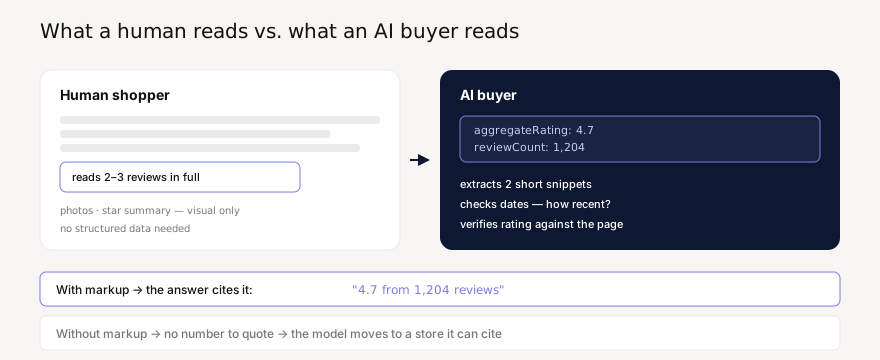
The review changed jobs
A review used to be a conversion tool: social proof a visitor reads before clicking Buy. The mechanism was emotional — "people like me were happy" — and the form was designed for a human eye: stars, photos, a helpful-votes widget, ten pages of comments. None of that machinery matters to an AI buyer, because the model experiences none of it as designed.
What matters now is the citation. When ChatGPT or Gemini recommends a product, it justifies the pick with evidence it can point to, and the rating is the most quotable evidence there is: one number, backed by a count, that the reader can verify by clicking through. The review has moved from the persuasion layer of your page to the evidence layer of an answer about you — an answer that happens on somebody else's surface, with or without your participation.
What an AI buyer can actually read
The readable parts are precise and narrow.
The structured block. Schema.org defines aggregateRating — ratingValue, reviewCount, and the scale (bestRating and worstRating) — plus review entries with reviewBody, reviewRating, author, and datePublished. These are the fields a model can extract unambiguously from your page source and quote back. This is the entire game; everything else is decoration.
The snippets retrieval surfaces. An LLM does not ingest your whole review wall. Its context holds a handful of representative snippets — usually the ones that match the query's intent. "Does it grind fine enough for espresso?" is answered by whichever review text contains grind-size detail, not by the average of all reviews.
The numbers that travel. Volume and recency are read as numbers: reviewCount says how much evidence exists, and datePublished on individual reviews says how fresh it is. A 4.9 from three reviews does not compete with a 4.7 from 2,300, and a review wall whose newest entry is from 2022 reads as a dead product.
And none of this happens if the crawler cannot reach the page. Reviews rendered by a JavaScript widget after load, hidden behind a login, or blocked in robots.txt are invisible to the AI layer no matter how glowing they are.
The three ways stores break their own evidence
1. No markup at all. The reviews exist; the model cannot quote them. This is the common case: in the benchmark, 77 of 120 stores returned no parseable Product structured data on sampled pages — no rating, no price, no availability for an agent to cite. The human shopper still sees the stars. The agent sees a page with no product on it.
2. The markup disagrees with the page. An inflated ratingValue, a stale reviewCount, a rating averaged across a different product than the page shows. When the structured block and the visible page conflict, the model cannot tell which is true, so it trusts neither — and Google's review markup guidelines treat exactly this pattern as a violation. A broken promise is worse than silence: silence merely omits you, a contradiction discounts you.
3. The reviews are walled off. Review widgets that render client-side, bot rules that block crawler user agents, reviews behind a "see all" tab. The shopper scrolls happily; the agent reads an empty page.
Making your reviews quotable
The work is small and specific.
Add aggregateRating to your Product block. ratingValue, reviewCount, and the scale, generated from the same source as the visible page so the two can never drift. If your platform does not emit it, a one-line template edit does. The full list of fields that decide recommendation is in the eight Product schema fields that matter.
Add review entries when you can. The snippets worth marking up are the ones that answer comparison questions — fit, durability, size accuracy, what the buyer compared it against. Those are the texts retrieval is most likely to pull into context and the model is most likely to cite.
Keep the dates moving. A review request sent two or three weeks after delivery keeps datePublished fresh and the average age low. Recency is one of the few signals the model can read without you marking anything up — but only if recent reviews exist.
Make the reviews crawlable. Server-rendered or pre-rendered markup, not a widget that runs after load; no bot blocks on the review paths.
Do not game it. Synthetic reviews and inflated aggregates are the one thing this layer is actively designed to catch. Models cross-check the rating against the page text and against other sources, and the platforms document the behavior. A fabricated 4.9 is a liability, not an asset, in a channel whose currency is quotable truth.
Reviews join the rest of your data layer
The rating does not stand alone. An AI buyer weighs it together with price, availability, return policy, and shipping — the trust bundle. A store with a perfect rating and an unparseable return policy still gets discounted on trust, because the model prefers the store it can verify on every axis it cares about. That pattern is covered in the policy blind spot in AI commerce.
The review wall is also a retrieval surface. Your customers write, in their own words, the exact queries future buyers will type into ChatGPT — "holds up in the dishwasher", "too big for a carry-on". Attribute-specific review text is long-tail coverage for agentic shopping queries, and unlike ad copy, it is written for free by people who already bought.
The long game: when comparison shopping is done by agents, the review stops being a conversion widget on your page and becomes part of the record the agent assembles about you — from your site, from feeds, from third-party sources. The stores whose records are complete and consistent get compared. The rest get skipped, reviews and all.
See what an AI buyer can actually cite from your store — run a free scan at prefero.me.