Adobe expects AI-driven traffic to US retail sites to grow 130% this holiday season — while paid search grows 4% and social 17%. The day-level AI numbers are sharper: +159% on Thanksgiving, +95% on Black Friday, +88% on Cyber Monday.
That surge will not be captured by the best-looking store. An AI buyer does not browse; it reads — a product sitemap with real URLs, JSON-LD that matches the live price, policies an agent can quote without guessing. In our published 120-store sample, only 4 of 120 were complete enough for an agent to compare with confidence. Most of that gap ships in an afternoon, and every fix on the checklist below also improves the channels you already measure.
The forecast, and the part you control
Adobe's holiday forecast, published in late September, projects $275.1 billion in US online sales between November 1 and December 31 — up 6.7% year over year — with a $47.5 billion Cyber Week. The composition of the traffic is the part worth reading closely: AI referrals up 130% year over year, against +4% for paid search and +17% for social.
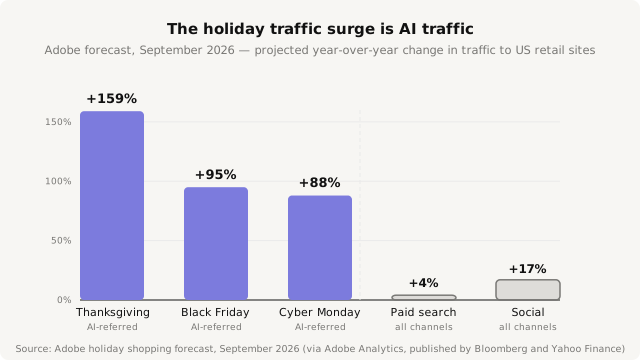
The honest caveat belongs here, because this blog has made it before: AI referrals are still a small slice of retail traffic — most measures put the channel near or under one percent of visits today. What is new is the slope, and the shopper behind it. Adobe's July survey of 5,000 US consumers found AI-referred shoppers generate 43% more revenue per visit and add items to carts at a 32% higher rate than shoppers arriving through other channels. A small channel that converts like that, growing 130% into the biggest quarter of the year, is exactly the kind of traffic you prepare for before it peaks — not after.
You do not control the surge. You control whether your store is readable when it arrives.
Traffic that cannot read you is traffic you pay for twice
The asymmetry nobody budgets for: the ads that produce this quarter's traffic still land on rendered pages. The agent that gets asked "best gift under $100, free returns" does not. It fetches whatever it can enumerate, parses whatever it can extract, and builds its shortlist from that. A store that renders beautifully and parses to nothing is paying for clicks that the fastest-growing buyer cannot act on — and the competitor that can be read gets the recommendation instead.
Our 120-store scan measured exactly how thin the readable layer is. Forty percent of stores could not be enumerated at all — no sitemap, or a sitemap with zero product URLs. Sixty-four percent returned no parseable Product structured data on the sampled pages. Fifty-eight of 120 served neither llms.txt nor agents.md. These are not obscure technical failures; they are the first three steps an agent takes before it can have an opinion about a single product.
The Q4 version of the problem is that the traffic arrives anyway — and when it does, the readable layer is what decides.
The Q4 pre-flight checklist
Five checks, in this order, because each one is worthless without the one above it.
| Check | What it prevents | How common the failure is |
|---|---|---|
| Product sitemap lists real product URLs | An agent that cannot enumerate the catalog cannot recommend from it | 48 of 120 stores |
Server-rendered Product JSON-LD with live price and availability | The agent quoting the wrong number, or skipping the product entirely | 77 of 120 stores |
Holiday return policy in hasMerchantReturnPolicy | Extended return windows are a Q4 purchase trigger — buried in prose, they are unquotable | cleared by 4 of 120 |
Retrieval crawlers allowed: ChatGPT-User, OAI-SearchBot, PerplexityBot, Claude-User | Live-query crawlers are distinct from training crawlers, and the two get blocked together by accident | 58 of 120 had neither intent file at all |
Tiebreak fields: brand, an identifier, aggregateRating, shippingDetails | Close comparisons are won on trust and risk, not price alone | the gap that left 4 of 120 standing |
Rows one and two take an afternoon each on most platforms. Row three is editing a JSON-LD block, not a policy. Verification is mechanical: paste a product URL into a schema validator and confirm the record an agent will read — not the page a shopper will see. None of this requires a replatform.
The holiday trap: your data changes faster than your schema
Every quarter has data drift, but Q4 concentrates it. Black Friday promos change prices daily. Extended holiday return windows replace the standard policy in October and expire in January. Flash stockouts flip availability mid-day. Each change widens the gap between the rendered page and the machine-readable record — and the agent quotes the record.
We wrote about the stale-price loop earlier this year: the page says one number, the JSON-LD says another, and the AI buyer cites the old one with total confidence. In Q4 the loop spins faster, because the page itself is moving. The fix is the same one applied harder: generate both layers from the same catalog object at render time, and set priceValidUntil so a sale price expires instead of lingering.
Photography-dependent categories have their own version of the drift. Agents read alt text and image metadata, not pixels. A holiday hero shot that replaces the old image without updating the record teaches the agent the wrong product — in the quarter when the visuals change most.
The pattern behind all of it: anything an agent learns this quarter, it repeats into January. A stale Black Friday price quoted to a January shopper is a discount you honor or a trust break you eat. Keeping the record true is cheaper than either.
What to do this week
The calendar makes this concrete. Adobe puts the October pre-season at $95.8 billion, including a $9.9 billion Prime Day on October 6–7 — tomorrow, as this post goes up. Thanksgiving lands on November 26, and Cyber Week opens seven weeks from today. Every check above is days of work, and none of it expires in January: the same readable layer serves rich results, shopping feeds and comparison sites all year.
See where your store stands before the surge — run the free scan and get your score against the 120-store benchmark. More on how the score is built.