Two stores can sit in the same AI buying answer and only one gets the click. The other is quoted, praised, and picked — rendered as prose with no link to follow. The shopper who wants it has to search for it, and some of them do not.
That is the last mile of the AI recommendation, and most readiness work stops before it. The sequence merchants have learned — crawlable catalog, readable product data, a record complete enough to win the comparison — ends the moment the agent picks you. What happens next belongs to the attribution layer: whether the answer names the store, links it, and treats its record as fresh enough to quote. That layer is decided by a small set of machine-readable signals, and when it fails, the failure leaves no trace in your analytics. There is only a recommendation that was yours, and a visit that went elsewhere.
The three fates of a store in an AI answer
Read a buying answer the way a store should, and every merchant mentioned in it lands in one of three buckets.
Named and linked. The answer recommends the product and attaches the store as a source — a link chip, a citation number, a footnote that resolves to the product page. This is the only bucket that produces a visit. The shopper reads the recommendation and reaches the store in one click, with the query's intent intact.
Named, no link. The store appears in prose. The answer says the product fits the shopper's constraints, names the brand, quotes the price — and provides no path to follow. The shopper who wants to buy runs a second search. Some do. The gap between "some" and "all" is a store's leak, and it happens after the store has already won.
Not named. The store's data shaped the answer without the store appearing in it. A price comparison used its record. A stock check read its availability. The mention went to another source, or to none. The store was consulted and rendered invisible.
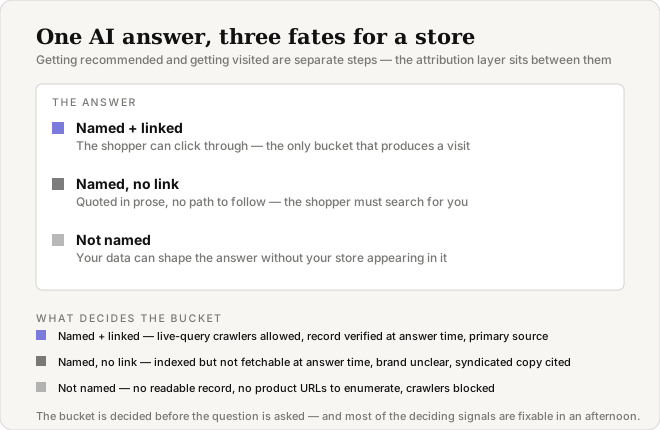
The buckets are not random, and they are not a ranking of the products. They are decided by signals the store controls, most of them before the question is ever asked.
What decides the bucket
Who is allowed to fetch the page at answer time. The crawler that matters at the moment of the question is not the one that built the model. Live-query crawlers — ChatGPT-User, Perplexity-User, OAI-SearchBot — fetch pages while the answer is being written, so the assistant can verify today's price instead of quoting the corpus. Training crawlers (GPTBot, ClaudeBot) do something different, and blocking the two groups together is the most common way a store ends up indexed but never verified. In our 120-store scan, 58 stores served neither llms.txt nor agents.md — no machine-readable statement of what matters on the domain — and the retrieval crawlers were the ones that got caught in the same net.
What the answer can quote as your name. The brand string an assistant repeats comes from the record, not the logo. The Product.brand field is the difference between a quotable "Waterproof Trail Jacket, $189 — in stock" and "a waterproof jacket from an outdoor store, around $200". In the 120-store benchmark, the completeness fields — brand, an identifier, aggregateRating, return policy, shipping details — were the exact fields missing on 116 of 120 records; only four cleared the threshold. A store that does not state its brand in the record invites the model to guess it, and a guessed name is a search the shopper cannot complete.
Whether the record is true at the moment the answer is written. A live fetch that finds a stale price or a stock status that contradicts the page is a reason for an assistant to drop the source, not to correct it. We have written about the stale-price loop: the page says one number, the record says another, and the agent quotes the old one with total confidence. At answer time the same loop is worse — the assistant is fetching because it wants something current, and the mismatch is what gets remembered.
Which copy of your product the agent cites. If the readable record lives on a marketplace or a feed and your own domain returns less, the citation follows the copy the agent could verify. The canonical record needs to be on your pages — canonical URLs and server-rendered schema, not a syndicated mirror. The full field list is in the product schema guide; the attribution point is narrower: be the source the answer can stand behind.
The leak no dashboard shows
A named-without-a-link recommendation arrives in your analytics as nothing, or as a brand search. There is no referral from a comparison that happened inside a model's context window — we have made that point about losing: there is no impression count for a candidate set you were excluded from. Winning adds a second silent loss on top: no referrer for a recommendation that named you and never linked you. The store does everything right, and the click still goes to whoever was clickable.
The honest caveat belongs here, as it does in the rest of this series: the channel is young, and most measures put AI referrals near or under one percent of visits today. The argument is asymmetry, not volume. The signals above cost days, not quarters, and they compound into every channel that reads the same records — rich results, shopping feeds, comparison sites. The cost of skipping them is a funnel leak at the one point where the shopper had already chosen you.
Read your own bucket this week
The cheapest check is to read an answer the way a store should. Ask the assistants your customers use for a buying question in your category — the one your best-selling product should win — and note your bucket: named and linked, named without a link, or absent. Then work the list in this order:
- Allow the live-query crawlers.
OAI-SearchBot,ChatGPT-User,PerplexityBot,Perplexity-User,Claude-Userinrobots.txt— kept separate from the training crawlers, which can stay blocked if that is the policy. - State
brandexactly as customers search it. One consistent string, everywhere the record appears. - Generate price and availability from the live catalog and set
priceValidUntilon offers, so an answer-time fetch never finds a contradiction. - Publish an
llms.txtthat names the store, points at product pages and policies, and says what the domain is for. The full how-to is short. - Keep the canonical record on your own domain, not on the marketplace copy. The source the agent can verify is the source the answer links.
None of this requires a replatform. It is the same discipline that made the product page readable, applied one layer further — from "the agent can read you" to "the answer can send the shopper to you". The comparison is won inside the model. The click is won on the page the model links. Winning the first and skipping the second is how a store gets recommended and still gets no visit.
See which bucket your store would land in — run the free scan and read the crawlability and completeness breakdowns. More on how the score is built is in the methodology.