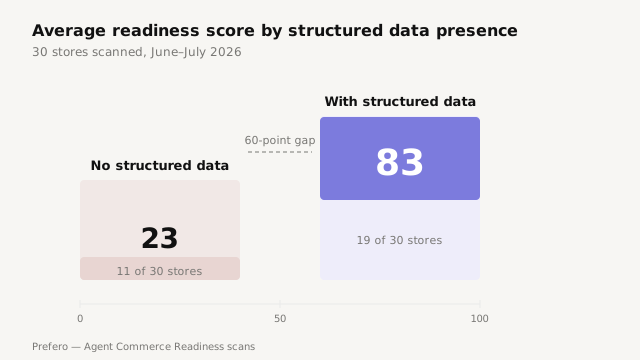
11 stores in our June–July scan batch had zero structured data on their product pages. No Product JSON-LD, no name, no price, no availability — nothing a machine could read. They averaged 23 out of 100 on overall AI readiness. The 19 stores that had at least some structured data averaged 83. The gap is 60 points, and it is not about design quality, page speed, or brand strength. It is about whether an AI buyer can read a single structured fact about a product before deciding whether to recommend it.
A store with zero structured data is invisible to an AI buyer — not hard to find, not partially understood, invisible. An agent like ChatGPT or Perplexity that receives a query for "a waterproof jacket under $200" cannot match a store that never told a machine its products exist, what they cost, or whether they are in stock. The agent does not guess. It recommends the store whose data it can read, and the zero-data store does not make the list. This is the finding from 30 scans of e-commerce stores across nine categories — apparel, footwear, coffee, beauty, pet supplies, furniture, luxury jewelry, baby goods, and fitness — run between June 9 and July 13, 2026.
What zero structured data actually means
Structured data is the JSON-LD block in a product page's source code — a Product schema that tells a machine the product name, the price, the currency, the stock status, the brand, and the image. It is unambiguous. A model does not have to parse it from prose, guess which number on the page is the price, or infer availability from a "sold out" badge rendered in JavaScript after page load. It reads the field and quotes it.
Of the 11 zero-SD stores, none had any Product schema at all. Not a partial block. Not a few fields missing. Zero. An AI buyer visiting any of these stores sees a page it cannot extract a single structured product fact from — the equivalent of a human shopper walking into a store where every product is in an unlabelled box.
This is not a niche problem. The 11 stores spanned luxury jewelry, fast fashion, specialty coffee, print-on-demand apparel, photography equipment, and baby goods. A heritage jewellery brand and a direct-to-consumer coffee roaster both failed the same way: no machine-readable product data. The category does not predict the outcome. The implementation does.
The double penalty: no data and blocked crawlers
Seven of the 11 zero-SD stores had another problem: their robots.txt blocked at least some AI crawlers, or their sitemap was missing or incomplete. These stores scored 40 or below on crawlability, the dimension that gates whether an agent can even reach the page. A store with no structured data and blocked crawlers is invisible twice — the agent cannot fetch the page, and if it could, it would find nothing it could use.
The combined effect is brutal on the score. A store with zero structured data and blocked crawlers scored 13 — the lowest in the batch. The scoring model weights structured data at 40% and crawlability at 20%, so losing both dimensions costs a store 60% of the possible points before the AI preference dimension even enters the picture.
Three of the 11 stores had perfect crawlability — their robots.txt was clean, their sitemap was present, and an llms.txt file guided the crawler to high-signal pages. But they still scored 33, because crawlability with nothing to read is a well-lit path to an empty room. An AI buyer that can reach every page but finds no structured data on any of them is no better off than one blocked at the gate.
The other side: what structured data buys you
The 19 stores that had at least minimal Product schema averaged 83 overall. The lowest-scoring store in this group had 53 — still 20 points above the best zero-SD store. The highest scored 94. Structured data is not the only variable — crawlability and AI preference vary within this group — but it is the prerequisite. Without it, the other two dimensions cannot compensate. With it, a store starts the evaluation with a floor the zero-SD stores cannot reach.
| Group | Stores | Avg overall score | Avg SD score |
|---|---|---|---|
| Zero structured data | 11 | 23 | 0 |
| Has structured data | 19 | 83 | 82 |
Four stores in the structured-data group had weak crawlability — their robots.txt blocked AI crawlers despite having solid product schema. They scored 61 to 82, paying a 20-to-36-point penalty on overall readiness because the agent could not reliably reach the data that existed. Their problem was access, not content — a much faster fix than adding structured data from scratch, but one they had not checked.
Why this happens
The most common reason a store has zero structured data is not a decision. It is a default. The store launched on a platform — Shopify, WooCommerce, a custom stack — and the theme or the app that would have added JSON-LD was never installed or configured. The product pages render beautifully to a human. To an AI agent they are blank.
The second most common reason is that someone added structured data once, it broke after a theme update or an app removal, and nobody noticed. Structured data is invisible in a browser — it lives in the source, not on the screen — so a field that goes missing does not trigger a visual regression. The store looks fine. It just stopped being machine-readable.
In both cases the fix is not a replatform. It is a template change, a plugin install, or a few lines of JSON-LD copied into the page head. The eight fields that carry the most weight for an AI buyer — name, price, priceCurrency, availability, brand, image, description, and sku — can be added in an afternoon. We covered them in the eight Product schema fields that decide whether AI recommends you.
What the 60-point gap tells us
The 60-point gap between the zero-SD stores and the ones with structured data is not about how good the data is. It is about whether it exists at all. The stores with schema ranged from 53 to 94 on structured data quality — some had complete, accurate blocks and some had gaps. But all of them cleared the first hurdle: an AI buyer could read something. The zero-SD stores never entered the evaluation.
This makes structured data the most binary dimension of AI readiness. Crawlability can be partially fixed — unblock a few user agents, add a sitemap. AI preference shifts with the competitor. Structured data, at the low end, is a switch: off or on. And for 37% of the stores we scanned, it was off.
The stores that scored zero on structured data are not an edge case. They are a third of the sample, drawn from real e-commerce stores whose owners chose to scan them — which means they are likely more attentive to their online presence than average. If a third of the stores that actively checked their AI readiness had zero structured data, the number across all e-commerce is almost certainly higher.
See where your store stands. Run a free scan at prefero.me.