In 28 of the 33 scans we completed between June 19 and July 30, the AI buyer never delivered a verdict. The most common reason was not the one merchants assume — a missing competitor URL accounted for 10 of the 28. The single biggest reason was that the store itself exposed no products an agent could read.
AI preference carries 40% of the Prefero readiness score, tied with structured data as the heaviest weight: the scanner simulates a buyer choosing between the scanned store and a real competitor, and the outcome of that matchup alone can move the total by 24 points. But the comparison can only run when both sides are readable. When it cannot, the scanner records why, marks the dimension neutral, excludes it, and recomputes the total over the remaining 60% of the weights. Across the 33 scans in the window, the comparison ran 5 times.
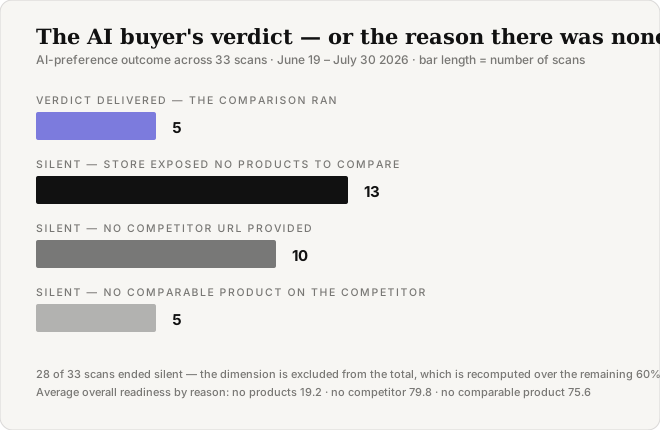
The three silences are not one silence. The stores behind each reason look nothing alike: the "no products" group averaged 19.2 overall readiness, the "no competitor" group averaged 79.8. (Nine earlier scans predate the pipeline change that records the reason for a silent comparison, so this analysis covers the 33-scan window.)
Silence, reason by reason
1. No products to compare — 13 scans. Thirteen of the 28 silent scans ended neutral because the pipeline extracted zero products from the store. There was nothing to put in front of the buyer model.
This was the weakest group in the cohort by a distance: average overall readiness 19.2, ranging from 13 to 33. All 13 scored zero on structured data. Eight also scored 40 on crawlability — llms.txt and agents.md missing — so an agent could neither enumerate the catalog nor read the intent files. The remaining five had better access setups: three were fully crawlable at 100 and still exposed zero products. Perfect access, empty catalog.
For these stores the comparison did not fail. It never existed. An AI buyer that cannot extract a product from your site cannot prefer you over anyone, and no competitor URL changes that. We covered what this invisibility looks like across a larger cohort in 11 of 30 stores have zero AI-readable product data.
2. No competitor URL — 10 scans. Ten scans were silent because no competitor was provided. This is the group merchants assume they belong to — and mostly they are right, but the profile is the opposite of the first group: average overall 79.8, with eight of ten at crawlability 100 and nine of ten carrying structured data. These are prepared stores that simply did not enter the comparison.
One exception is worth noting: a single store in this group had products on its pages but no structured data on any of them and no intent files, and scored 13 overall. Not every "no competitor" scan is a store that skipped the field; a few simply have nothing readable to compare yet.
3. No comparable product — 5 scans. Five scans provided a competitor URL and still received no verdict, because the scanner could not match a comparable product on the competitor's side. This group is the most counterintuitive, because none of the usual suspects explain it: all five stores had structured data, and the group averaged 75.6 overall. The stores did their part. The matchup never materialized.
Earlier in the summer we reported that most neutral scans were merchants skipping the competitor field. The newer data — every silent comparison now records its reason — tells a more precise story: skipping is real, but it is the second most common reason, not the first.
The five verdicts that did land
Five scans produced an actual AI-preference score: 40, 80, 100, 100, 100. The entire outcome range happened within one month. A 40 means the simulated buyer preferred the competitor; a 100 means the scanned store won every persona. The gap between those two outcomes is 24 points of overall readiness — larger than the entire crawlability dimension. How the dimension works, and what a 40-versus-100 matchup teaches, is in the AI preference dimension that decides the winner.
Five verdicts out of 33 is not a failure rate of the scanner. It is a property of the market it measures: a comparison requires two readable sides, and for the vast majority of stores scanned, one side — usually their own — was not there.
How to read the silence
A neutral AI-preference result is the scanner refusing to guess, and the reason it records is the most actionable line in the report:
- "No products" is the loudest silence. It means your store is invisible to an agent end to end. Fix enumeration and structured data before anything else — a competitor URL is wasted on a store with nothing to compare.
- "No competitor" is the only silence that is a choice. If your structured data and crawlability are in place, this is the dimension you are leaving unmeasured. Bring a competitor URL on your next scan.
- "No comparable product" is a matching problem, not a verdict on you. Scan against the competitor your customers actually cross-shop — one that sells the same kind of product.
The score you get today tells you which of these silences is yours. The way to turn silence into a verdict is to make your catalog readable first — and then pick an opponent.
See which reason your scan would record. Run a free scan at prefero.me.